




Introduction: In November, the APEC Economic Leaders' Informal Meeting will be held in Shenzhen. As geopolitics increasingly encroaches on the economic and trade sphere, and protectionism and bloc formation continue to rise, can a cooperation mechanism that relies on consensus rather than coercion, and openness rather than exclusivity, continue to unite common interests in an era of growing division?
At the 13th International Conference of IPP, Edward Yau, former Secretary for Commerce and Economic Development of the Government of the Hong Kong Special Administrative Region, delivered a keynote speech, in which he focused on the real predicaments and future way forward of APEC. He pointed ut that APEC is currently facing multiple crises, as the achievements of decades in trade liberalization accumulated over decades are being eroded by tariffs, export controls and unilateral sanctions. However, APEC's scale, its pragmatic and flexible tradition of cooperation, its resilience to withstand crises and its regional coordination capabilities have not disappeared; the bilateral and plurilateral trade agreements spread across the Asia-Pacific region further constitute an institutional life jacket in the storm. He advocated rejecting a closed club-like pattern and using existing mechanisms such as RCEP and CPTPP to re-promote regional trade liberalization.
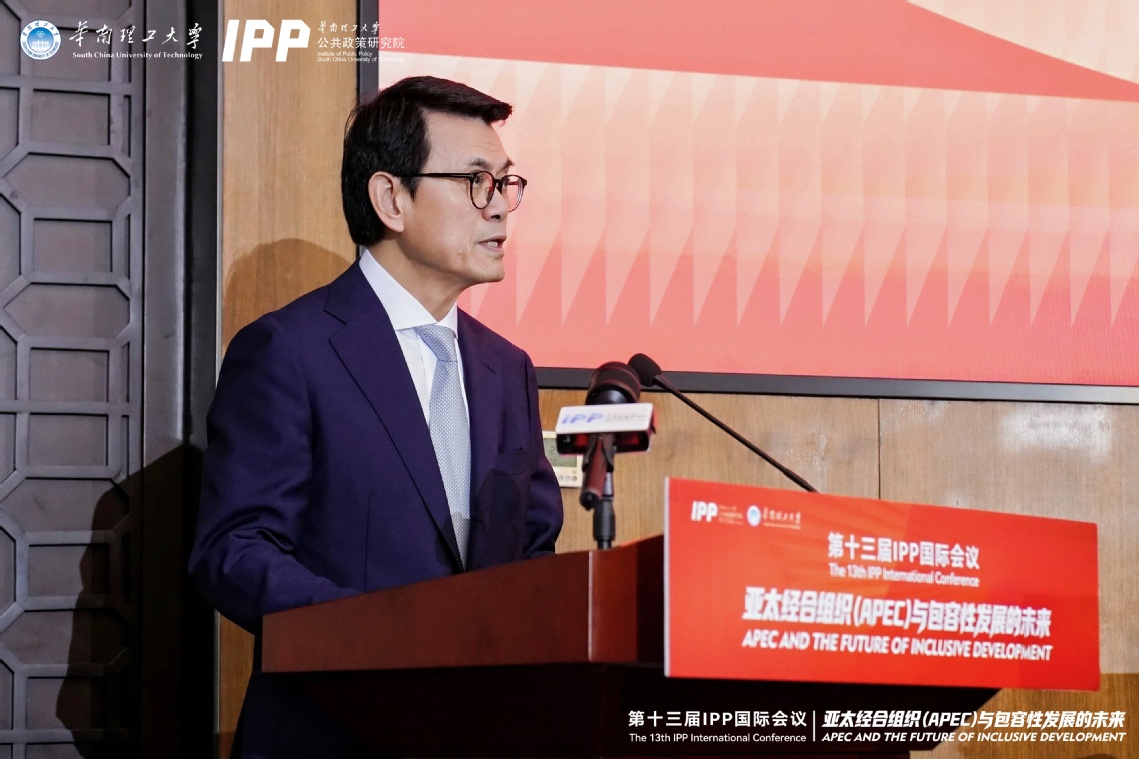
Edward Yau, former Secretary for Commerce and Economic Development of the Government of the Hong Kong SAR and Non-resident Distinguished Fellow of Centre on Contemporary China and World (CCCW) at the University of Hong Kong, delivered the keynote speech Source: IPP
Good morning, distinguished guests, ladies and gentlemen.
It is indeed my honor and privilege to speak at this forum, organized at a critical juncture with such a distinguished group of participants—all eager to see the success of our country in hosting APEC 2026 conference especially its upcoming Leaders’ Meeting. The fact that we gather during a troubled time in geopolitics underlines the significance of this opportunity as a genuine window of hope.
I believe most, if not all, participants hold high hopes for the smooth conduct and fruitful outcomes of the Shenzhen APEC summit.
I share this wish wholeheartedly especially with my decades long association with APEC as Hong Kong’s ministerial representative, but being a loyal friend of APEC, I cannot deny my concern if and how we can keep APEC afloat in an age of friction—and how this prominent organization can remain a beacon during and after the storm, as titled in my address today.

November 15, 2018, Edward Yau Tang-wah (left), then Secretary for Commerce and Economic Development of the Hong Kong SAR Government, delivered a speech at the plenary session of the 30th APEC Ministerial Meeting. Source: Government News Portal of HKSAR
Let me begin by putting before you a question that leaders of APEC economies can no longer avoid: Is APEC still relevant? Is it still functioning as a beacon of light for its long-advocated open regionalism, or is it slowly guttering toward exhaustion under the gathering storm of trade wars and geopolitical conflicts going against free and open trade?
Forgive me if this sounds blunt and harsh. But as an interested observer of international relations—speaking to you today without my old hat as a minister of trade—candor is being called for than diplomatic platitudes. We simply cannot afford to bury our heads in the sand.
There is every reason to ask this thorny, pointed question because the structural foundations of our regional cooperation are under immense stress. To put it plainly and graphically, APEC is vulnerable as all four letters in APEC appear to be under threat in the face of our current challenges:
First, look at the letter “A.” The Asia-Pacific is facing a profound identity crisis. We have all witnessed deliberate attempts to substitute a new geopolitical nomenclature—for instance, the Indo-Pacific—in place of the Asia-Pacific. This shift serves only to blur the core boundaries of the geographic and economic region where APEC is firmly premised.Concurrently, the creation of competitive, security-oriented partnerships like the Indo-Pacific Economic Framework (IPEF) and the Quad risks driving a wedge within APEC economies and among its neighbors.Let us be clear: an Asia-Pacific region with Asia missing or undermined is not just nonsensical; it is dangerous and divisive.

In July 2026, the foreign ministers of the United States, Japan, India, and Australia held an Quad meeting, extending the scope of cooperation to areas such as maritime security, economic security, and key technologies. Source: Reuters
Secondly, look at the letter “P.” The Pacific, historically a peaceful ocean where trade and commerce surfed comfortably on the trade winds, no longer guarantees smooth sailing. If we fail to exercise vigilance, sweeping tornadoes from nearby conflicts and war zones risk spilling over into our region, hitting our waters even harder than before.

The South China Sea and its surrounding waters are one of the most important maritime trade routes in the world. Source: Getty Images
Thirdly, look at the letter “E.” Our Economic focus risks being overridden by politics and security. To rephrase a famous political quote: “It’s politics, not the economy, stupid!”
Increasingly, national security has become the most abused justification for throwing globalization into reverse gear. Trade—once our primary tool to fix economic problems—has been thoroughly weaponized, and toying with tariff and trade sanctions have caused wounds, multiple and self-inflicting included. Globalization is now treated as a political scapegoat for domestic issues ranging from income disparity and trade deficits to immigration and development deficits.
Finally, look at the letter “C.” Cooperation is losing ground to confrontation. We are witnessing a fragmented economic landscape driven apart by hostility between players who were once close and complementary allies. The world's largest economies are locked in protracted trade disputes and politically manufactured tensions, driven by a highly volatile flashpoint in US-China dynamics. Worryingly, these systemic tensions are now spreading far beyond the two sides of the Pacific.
These are the realities keeping leaders and ordinary citizens awake in the middle of the night. They signal that APEC is no longer as forthcoming in bringing the region economic prosperity and development as its name proudly proclaims.

On August 27, the opening ceremony of the 3rd Senior Officials' Meeting of the 2026 APEC was held in Dalian, Liaoning Province. Photo: Xinhua News Agency
Earlier this year, at a separate forum held in Shenzhen, I suggested that APEC is a patient suffering from self-inflicted wounds,and I used a traditional Chinese medical framework—Wang, Wen, Wen, Qie (望、聞、問、切)—to diagnose its ailments.
But as APEC prepares for the upcoming leaders' gathering, it is high time to pull our heads together to find cure than mere diagnosis. In so doing, the ultimate question remains: Is APEC worth preserving, and if so, how do we fix it?
Let us try to address this by looking at our situation through three clear lenses:
(a) what made APEC successful in the first place
(b) what has fatally changed
(c) why APEC remains vital to our collective survival
The Core Pillars of the APEC Miracle
To evaluate whether APEC faces a permanent setback or can achieve a historic turnaround, we must first return to its origin and recall why it was forged in the first place.
As many of us remember, APEC was inaugurated at its first ministerial meeting in Canberra on November 6–7, 1989, convened by Australian Prime Minister Bob Hawke and bringing together 27 ministers from 12 founding economies.

From November 6 to 7, 1989, the first APEC Ministerial Meeting on Economic Cooperation was held in Canberra, Australia. Ministers and representatives from 12 economies gathered to launch the process of economic cooperation in the Asia-Pacific region. Source: APEC
The primary driving forces behind its creation were clear: to counter the emergence of preferential trading blocs—specifically the single market expansion of the European Economic Community and the US-Canada Free Trade Agreement—and to break the paralyzing stalemate of the GATT Uruguay Round.
Crucially, APEC was conceived as a vital counterweight to shield Asia’s dynamic, export-oriented economies, while championing a far higher global ideal: proving to the world that open trade beyond discriminatory regional walls was still viable. This looked promising and visionary.
It is this concept of open regionalism that fundamentally set APEC apart from traditional trade blocs. At the core of its founding philosophy was the noble conviction that regional trade concessions should be extended globally on a non-discriminatory, Most-Favored-Nation (MFN) basis.
This approach encouraged voluntary, unilateral tariff reductions that catalyzed collective economic growth without forcing member economies to retreat behind protectionist barriers. From day one, this defined APEC’s strategic positioning as a GATT/WTO-Plus incubator—driving collective regional efforts toward a vision far bigger than its immediate geo-economic boundaries, and at a pace far ahead of slow-moving multilateral negotiations.
In both principle and practice, APEC succeeded as a pioneering incubator for behind-the-border structural reforms and a builder of global trade architecture.

In 1994, APEC established the Bogor Goals to promote the gradual realization of free and open trade and investment in the Asia-Pacific region. Source: APEC
Leveraging its non-binding, consensus-driven nature, APEC spearheaded early frameworks on cross-border investment, customs modernization, e-commerce, and regulatory coherence—tackling complex non-tariff barriers even as traditional tariffs continued to fall.
APEC’s “open regionalism” proved that regional agreements could serve as stepping stones rather than stumbling blocks for free trade.
Speaking from my own personal experience—having served as a participating minister in both the environment and trade portfolios, and as chief of staff to my APEC Economic Leader—I can attest that APEC discussions and negotiations were, until the current tide turned, remarkably pragmatic, problem-solving, and reassuring.
Exactly because the focus was on tearing down walls rather than building them up, APEC was able to drive economic growth and foster shared prosperity. Throughout most of my tenure, while drafting ministerial and leaders' declarations was always an arduous and lengthy exercise, those statements almost never failed to reiterate APEC’s unwavering commitment to serve as a building block for the multilateral trading regime, nor did they waver in our categorical determination to uphold the multilateral trading system with the WTO at its core.
The key question before us today is whether this very spirit, along with its self-assured vision, can still endure the storm.
In addition to its founding goals, APEC possesses essential core attributes, which I summarize as the five “Ss.” I venture to say that despite prevailing headwinds, these elements still retain incredible underlying strength:
1.“Size and Scale”
APEC is not just another regional talking shop; it represents the heavy center of gravity for the global economy. Our 21 member economies together comprise approximately 38% of the world's population, generate over 60% of global GDP, and drive nearly 50% of global trade. You cannot bypass or ignore an economic bloc of this magnitude.
2. “Significance”
The region remains the undisputed engine of global growth. According to the International Monetary Fund (IMF), the Asia-Pacific accounts for roughly 60% of all global economic growth. Even during periods of widespread macroeconomic consolidation, APEC’s expansion consistently outpaces the global average.

Data shows that the APEC region's economy grew by 3.3% in 2025; it is projected to grow by 3.2% in 2026, higher than the global average of 3.0%; and it is expected to grow by 3.0% in 2027. Despite multiple uncertainties facing the global economy, the Asia-Pacific region remains an important engine for global economic growth.
3.“Savviness”
There is a deep-seated economic, pragmatic intelligence native to this region. Even at the height of bitter trade frictions, APEC economies successfully finalized and implemented the Regional Comprehensive Economic Partnership (RCEP), steadily integrated under World Trade Organization (WTO) principles, and consistently prioritized keeping diplomatic channels open. Leaders remain highly motivated to use APEC as a premium venue for economic diplomacy.
4.“Sailing Rather Than Sinking”
APEC has demonstrated a unique capacity to sail against the tide.
Experience tells us that APEC survived the Asian Financial Crisis and post-9/11 security shocks through collective efforts to prevent the regional economy from spiraling downward and breaking apart.
Pro-trade, business-facilitating, collaborative policies coupled with targeted capacity-building efforts were the common tools we successfully deployed. Even in the current trade war era, the majority of APEC economies have pushed forward through adjusted supply chains and robust intra-regional trade networks, keeping businesses sailing ahead despite the headwinds.
This resilience has allowed the bloc as a whole to navigate global storms far better than other highly institutionalized regions, such as the European Union, or even North America under the USMCA, where we have seen pauses and friction as recently reported.
5.Synergy
There is an unusual, resilient chemistry within APEC's community. It relies on the Asian way of dealing with conflict—emphasizing consensus, voluntary commitments, and flexibility.
ASEAN as a group has brilliantly demonstrated solidarity despite its internal diversity and economic disparity, serving as a vital stabilizing force. Its ASEAN Plus One frameworks and collective engagement with regional partners have provided a proven formula for synergy. The extension of this approach into a binding regional trade agreement like RCEP is a clear manifestation of the mutual gains possible under the open regionalism APEC has aspired to since its inception.
This architecture provides enough diplomatic cushion for leaders to meet in maintaining instead of breaking ties, and to talk instead of attacking.
Furthermore, let us not overlook the critical synergy operating in tandem with this through the APEC Business Advisory Council (ABAC), which ensures that real-world commercial cooperation runs parallel to political dialogue.

Official group photo of the 3rd Plenary Session of the APEC Business Advisory Council (ABAC) in 2026. Photo source: APEC
The Hurting Realities and Systemic Damage
We cannot, however, mistake resilience for immunity. The damage being inflicted on our trading system is real, systemic, and deeply painful to all.
Consider the reversal of our tariff progress. Over the lifetime of APEC—representing decades of collective effort—targeted economic cooperation managed to bring average regional tariffs down from 17% to roughly 5%. This was a remarkable success, until the tide reversed almost overnight. Today, that historic achievement faces severe rollbacks. Punitive tariffs, sweeping export controls, and unilateral sanctions have broken the very guardrails that once sustained trade liberalization. Worse still, reversing this protectionist damage will be incredibly difficult, if not impossible, without immense pain and suffering.
What does this mean for APEC?
This shift has effectively put the long-term vision of a comprehensive Free Trade Area of the Asia-Pacific (FTAAP) on ice.
First, Nominal Costs: It imposes immediate, hard financial penalties on businesses, drives up structural inflation, disrupts regional supply chains, and dampens overall consumer demand. Secondly, Systemic Erosion: It dismantles institutional trust.
When multilateral dispute settlements are replaced by unilateral coercion, economic relations degrade into a zero-sum game—a toxic dynamic where one partner's gain is inevitably viewed as another's loss. The common defense is no longer mediation, but retaliation, which unfortunately deepens the self-inflicted wound.
Yet, there are inspiring exceptions to this trend. Look at Hong Kong’s unique experience: First and foremost, we are not spared from the trade war attack. But we steadfastly maintained our principled status as an open and free market, imposing zero tariffs in response to hostile and unjustified trade restrictions elsewhere. Remarkably, the result was not a decline in our trade share, but a rise to a record global ranking as the world's 5th largest trading entity in goods trade last year. This demonstrates the ultimate victory of free market and open trade in practice.

According to the data from WTO, Hong Kong's total merchandise trade volume in 2025 reached $1.585 trillion, a year-on-year increase of 17.5%, making it the world's fifth-largest merchandise trading entity, rising two places from 2024. Source: Reuters
Nevertheless, the region as a whole has been suffering. We see the damage of this friction clearly in the trade and economic statistics. Across APEC, the momentum of growth is visibly slowing, with regional GDP growth projected to moderate down to 2.9% this year. The sporadic trade growth observed recently is deceptively artificial—repeatedly driven by businesses desperately frontloading shipments to avoid impending tariff deadlines and threats of escalating trade tensions.
It is also common to see earlier yearly projections adjusted downward midyear to reflect emerging conflicts, resulting in severe trade policy uncertainty, stalled investment, and a sharp erosion of business confidence.
True, there are exceptional growth experiences among selected member economies in the APEC region, including China, several ASEAN members, and Hong Kong. For instance, China recorded a history-making merchandise trade surplus close to 1.2 trillion US dollars in 2025.
This, however, is a double-edged sword. While it underscores China's exceptional industrial competitive edge, such an extreme trade imbalance is reactive and can inadvertently stoke anxiety and political discomfort among trading partners. It risks adding fuel to protectionist fires if interpreted through a zero-sum lens.
That is why clear-minded leaders and academics always arrive at the same conclusion: there is no winner in a trade war.
The Life Jackets in the Storm
So, are we losing all hope that APEC can survive?
I refuse to be overly pessimistic. I still pin my hope on the key fundamentals we in APEC built together over the past decades.
Our economic integration runs too deep to be unraveled by political rhetoric alone. The region is held together by an intricate web of nearly 200 bilateral and plurilateral trade agreements—representing close to half of all trade pacts globally.
This network includes extensive, high-standard agreements between steadfast advocates of free trade, bringing together economies that would never share a pact if aligned purely by political affiliation. These act as our institutional life jackets.
Except for a very limited number of disputes recently in the news, most of these agreements in APEC are functioning well and maintaining a predictable, rules-based trading environment among contracting parties.
In addition, we are seeing a profound shift where geo-economics is quietly neutralizing the extremes of geopolitics. We hope to see the pendulum to swing back from its extremes.
It is therefore worth consider these critical developments as sign of hope:
1.The China-ASEAN FTA 3.0
This timely upgrade reinforces the powerful supply chain synergies between China and Southeast Asia, demonstrating how modern trade can operate as a win-win arrangement rather than a zero-sum dispute.
2.The Expansion of RCEP
RCEP stands out as a triumph of pragmatism over political alignment. It brings highly diverse, politically competing nations into a shared, structured tariff-reduction roadmap. By focusing on practical regional integration and preparing for future membership expansion, RCEP embodies the philosophy of not letting the perfect be the enemy of the good.
More importantly, its existence demonstrates the return of economic rationality over extreme geopolitical divides.
Furthermore, APEC has proven to be an indispensable venue for great-power dialogue. It is naive to think APEC can be entirely insulated from geopolitics, but it provides a uniquely stable arena where adversaries are obliged to sit at the same table.
As we have witnessed, Russia continues to participate in APEC despite intense hostility from certain Western allies due to the war with Ukraine, and US and Chinese leaders have consistently utilized this annual forum for vital trade, tariff, and high-level political dialogue in spite of the exchanges of trade weapons.
We saw this clearly in November 2023, when President Xi Jinping traveled to San Francisco at the height of intense trade frictions. Looking ahead to the upcoming Economic Leaders' Meeting this November 2026 in Shenzhen, the continued high-level engagement from major global leaders underscores APEC’s enduring diplomatic charm.
Put simply, when a unified joint statement is difficult to negotiate, a face-to-face meeting, a quiet pull-aside conversation, or even a shared photograph sometimes speaks better than words—building bridges across deep political divides that are essential in holding the line against a further spiral of mistrust.
Conclusion: A Pragmatic, Inclusive Way Forward
If we want to keep APEC from fading into exhaustion, I firmly believe we must anchor our efforts around five pragmatic pillars:
1.Rejecting the Closed Shop Dynamic, which goes against APEC tradition and values
First and foremost, for APEC to stay relevant, it must absolutely refuse to become a closed shop where one or two dominant parties take all the spoils. We cannot bow to the pressure of economic coercion, nor can we claim to achieve mutual prosperity if the system only produces a handful of winners. True regional resilience means resisting unilateral pressure while ensuring that economic benefits are safely and broadly shared across all 21 economies.
The commitments to drive economic policies that provide for all our people to participate in and benefit from the economy, fostering an environment that is inclusive, as stipulated in the Putrajaya Vision 2040, and the reinforcement of delivering benefits for all our people in the San Francisco Principles, must be fiercely upheld.
2.Upholding Host Responsibility and Inclusive Leadership
In this regard, a tremendous responsibility falls upon China this year. As the largest trading entity in the region and the host of this critical APEC summit during a time of compounding global challenges, China must actively ensure that APEC remains a forum for ALL its members. No economy should be sidelined; no partner should be left behind. True leadership means leveraging host status to reinforce a rules-based, open architecture where the smallest developing economy has the same voice and stake as the largest superpower.
I have every confidence that China will rise to this occasion.
3.Fostering Shared Value in Common Prosperity
We must foster shared value across the wider trade in both goods and services. While China undeniably enjoys a massive structural edge in manufacturing capability, the broader economic pie is far larger than factory output and export figures alone.
The optimization of regional supply chains, e-commerce enhancement, streamlining of customs facilitation, a continued commitment to market opening, and the boosting of local consumption to embrace imports are all avenues ripe for growth. More importantly, unleashing the growth potential of trade in services is completely up for grabs by all member economies.
High-growth sectors—such as clean and renewable energy, digital technology, and green environmental services—offer immense market potential alongside the economic and social improvements badly needed by everyone. This potential can be fully realized provided that regional trade flows are not artificially hindered by protectionist barriers or political alignment.
This is precisely the open environment a good host can push for, and collective leadership must reinforce.
4.Realigning Around Plurilateral Building Blocks
While a total, region-wide FTAAP may be a more distant goal than before, we must not lose hope. Rather, we must reinforce flexible, existing arrangements like RCEP and the CPTPP as the practical foundations to slowly reignite trade liberalization from the ground up, proving that economic integration remains viable even in a fractured world.

On May 22, 2026, members of RCEP and CPTPP held their first dialogue meeting.
5.Deepening Track-Two Business Involvement
When official diplomatic channels lock up, the private sector must step in as a stabilizing anchor. By maintaining robust dialogue through ABAC and tracking private-sector priorities, we ensure that commercial realities, supply chain integrity, and cross-border partnerships continue to drive the regional agenda forward.
APEC cannot afford to watch global economic challenges unfold like passive spectators at a World Cup match. We are players on the field, and more importantly, we are all on the same team under APEC’s flag.
From the firsthand experience I have had in the APEC ministerial processes throughout my career, I know that this is not an easy battle. Perhaps this is by far the worst storm we have ever encountered. It is hard to say whether we will win, but we all know that if we cannot win, we will be out—and we all stand to lose. Forgive me if I have sounded too blunt or undiplomatic.
I thank the organizers for giving me this exceptional opportunity to share my thoughts alongside such distinguished speakers.
By embracing our structural interdependence, practicing open regionalism, and focusing on pragmatic cooperation over ideological division, we can ensure that APEC remains what it was always meant to be: a powerful, steady beacon of shared prosperity in the Asia-Pacific.
Let us hope for APEC’s best.
Thank you.

Mr. Yau responded to the questions during the interactive session of the meeting. Source: IPP
Mr. Yau delivered a keynote speech at 13th IPP International Conference. Source: IPP

The Chinese version of Mr. Edward Yau’s speech:
重磅|邱腾华:风暴中的灯塔——如何在困难时代护航APEC行稳致远
相关报道: