



GUANGZHOU, China, Aug. 23, 2026 — With the 33rd APEC Economic Leaders’ Meeting set to be hosted by Shenzhen later this year, scholars and researchers from APEC member economies including Russia, Singapore, Australia and the Republic of Korea gathered at South China University of Technology (SCUT) to debate the future of APEC and inclusive development in the Asia-Pacific.
Held under the theme “APEC and the Future of Inclusive Development,” the 13th International Conference of the Institute for Public Policy (IPP) of SCUT took place on Aug. 23, 2026, on the university’s Wushan Campus in Guangzhou. Participants explored the future of regional cooperation in the Asia-Pacific, seeking to build consensus and provide intellectual support for openness and cooperation in the region.
The meeting came as APEC, founded in 1989, sails into headwinds of resurgent protectionism and mounting pressure on globalization. With the Shenzhen summit approaching, the conference sought to provide intellectual input on whether the forum can sustain its tradition of cooperation and keep charting the region’s development course — what the organizers described as building a bridge of mutual learning for openness and cooperation in the Asia-Pacific.
In his opening remarks, Mai Junhong, Deputy Secretary of the CPC Committee of SCUT, noted that amid a complex and volatile global environment, artificial intelligence and the green, low-carbon transition are opening new space for Asia-Pacific development. Sustaining an open, cooperative regional architecture that benefits all economies is a shared responsibility, he said, adding that SCUT is expanding academic exchanges across the region and leveraging its think tank expertise to help the Guangdong-Hong Kong-Macao Greater Bay Area (GBA) serve as a front-line hub linking China with the Asia-Pacific.

PMai Junhong, Deputy Secretary of the Party Committee of South China University of Technology, delivered a speech at the meeting.
Zheng Yongnian, Convener of the Conference and Chair of IPP’s Academic Committee, said the stability of APEC depends to a large extent on cooperation among major powers. He attributed the current difficulties in the US-China relationship to global economic imbalances accumulated since the 2008 financial crisis. Restoring balance, he argued, requires going beyond China and the US and expanding global demand through holistic worldwide development. “Economic decoupling between China and the US is neither realistic nor feasible,” Zheng said. “On the contrary, there is a solid foundation and genuine demand for cooperation.” With multiple opportunities for engagement between the two countries’ heads of state in the coming months, he expressed confidence that the two countries can maintain cooperation and strategic stability, contributing to peace and development in the world.

Professor Zheng Yongnian, convener of this academic conference, Chairman of the IPP Academic Committee, delivered the opening address at the conference.
In the keynote address, Edward Yau, former Secretary for Commerce and Economic Development of the Hong Kong SAR Government and Distinguished Non-resident Fellow at the Centre for Contemporary China and the World of the University of Hong Kong(CCCW), spoke on “Beacon and the Storm: Keeping APEC Afloat in an Age of Friction.” He examined the four dimensions of APEC — Asia-Pacific identity, peace in the Pacific, economic orientation and a spirit of cooperation — and the challenges each faces today. Noting that more than 200 trade agreements across the region have woven a “life jacket” of institutions — alongside the upgraded China-ASEAN Free Trade Area and the deepening Regional Comprehensive Economic Partnership (RCEP) — Yau said geopolitical differences have not halted regional economic cooperation. In his view, APEC, as an open platform connecting economies at different stages of development, is demonstrating the enduring value of its long-accumulated tradition of dialogue and cooperation. He expressed hope that China would exercise leadership as APEC host in defending open regionalism, and called on all parties to abandon zero-sum thinking.

Edward Yau, former Secretary for Commerce and Economic Development of the Hong Kong Special Administrative Region Government and Honorary Research Fellow at the Centre for Contemporary China and World Studies, The University of Hong Kong, delivered keynote speech.
The conference was organized around three interlocking themes: “APEC at a Crossroads: Institutional Logic, Membership and Non-Institutional Challenges,” “Asia-Pacific Economic Integration: Trade, Industrial Policy and Economic Security,” and “Innovation and Inclusive Development.”
Under the first theme, Shiro Armstrong, Professor of Economics at the Crawford School of Public Policy, Australian National University; Jayant Menon, Senior Fellow at the ISEAS – Yusof Ishak Institute and former Chief Economist of the Asian Development Bank; and Wang Jiangyu, Associate Dean and Professor of Law at the City University of Hong Kong, offered reform and development proposals for APEC from different perspectives.
Under the second theme, Xing Yuqing, Professor of Economics at the National Graduate Institute for Policy Studies (GRIPS) in Japan; Ji Xianbai, Associate Professor at Renmin University of China; Mehri Madarshahi, Honorary Professor of IPP and vice chair of the Asia-Pacific Exchange and Cooperation Foundation; and Ivan Danilin, Deputy Director for research at the Primakov National Research Institute of World Economy and International Relations (IMEMO), offered in-depth analyses of the current state and prospects of Asia-Pacific economies and industries.
Under the third theme, Chul Chung, President of the Korea Economic Research Institute; Guillaume Lafortune, Vice President of the UN Sustainable Development Solutions Network (SDSN) and Professor of Economics at Sunway University in Malaysia; and Hans d’Orville, Honorary Professor of IPP and former Deputy Director-General and Assistant Director-General for Strategic Planning of UNESCO, looked ahead to the prospects of artificial intelligence, sustainable development and other fields, highlighting the importance of inclusive development.
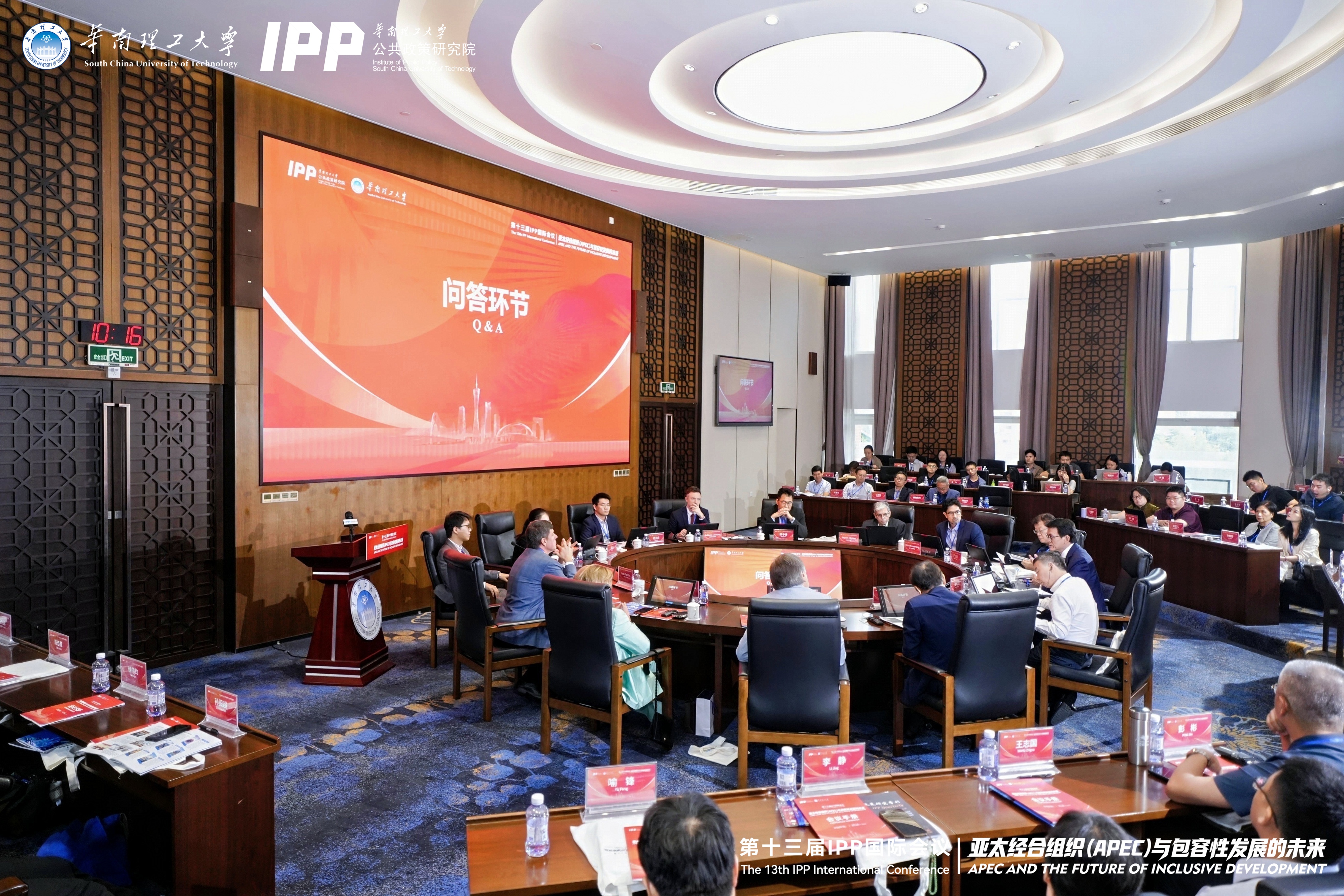
During the Q&A session, the attending guests engaged in an enthusiastic discussion.
IPP is a China Top Think Tank affiliated with South China University of Technology. Its annual international conference, now in its 13th edition, is among the most policy-influential think tank forums in South China, bringing together scholars, industry experts and policymakers from around the world. Under the leadership of Zheng Yongnian, IPP focuses on major issues in the evolving global landscape and seeks to bring China-inspired perspectives into global governance discussions.

Group phote of the attending guests