



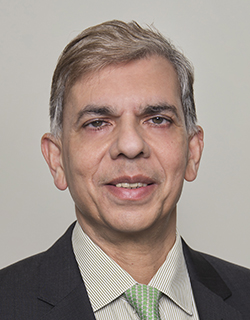
Dr. Jayant Menon
Senior Fellow at ISEAS – Yusof Ishak Institute and Former Lead Economist at the Asian Development Bank
Speaker Bio:
Dr. Jayant Menon
Visiting Senior Fellow, ISEAS – Yusof Ishak Institute, Singapore
Jayant Menon, Ph.D. joined the ISEAS – Yusof Ishak Institute in 2020 as Visiting Senior Fellow to continue his work on trade and development in the Asian region, following a long career at the ADB. His last post at the ADB was Lead Economist (a Director level post) in the Office of the Chief Economist. He began work life as an academic in Australia, spending almost a decade at the Centre of Policy Studies at Monash University, world-renowned for computable general equilibrium modelling. He also worked at the University of Melbourne, Victoria University, the American University in Washington, DC and the ADB Institute in Tokyo. He has served as a Board Director of CDRI, Cambodia, and on the Advisory Board of the University of Nottingham, Malaysia. He holds adjunct appointments with the Australian National University, University of Nottingham, UK and IDEAS, Malaysia. He has authored/edited more than 15 books, 50 chapters in books, and 80 articles in peer-reviewed journals.He is a co-editor of the Journal of Southeast Asian Economies and book review editor for the Journal of Asia-Pacific Economy. He serves on the editorial board of several academic journals including the Journal of Asian Economics, Asian Economic Journal, Journal of Asian Economic Integration and Foreign Trade Review, among others. He holds a Bachelor of Economics with Honours (First Class) from La Trobe University, and a Masters and a Ph.D in Economics from the University of Melbourne.
Lecture Topic:
The Return of the Trump Tariffs: The Four Options Facing Exporters
President Donald Trump’s ‘reciprocal tariffs’ came into effect on 7 August 2025, before the United States (US) Supreme Court ruled on 20 February 2026 that the International Emergency Economic Powers Act (IEEPA) did not provide him the authority to impose such tariffs. Following this, Trump immediately resorted to Section 122 of the Trade Act of 1974 to impose a global surcharge of 10 per cent on almost all goods. It is clear that the Trump administration has used the 150-day window provided by Section 122 to try and reimpose the tariffs that applied prior to the ruling, using Sections 301 and 232. On 11 March 2026, the USTR launched a massive new “Section 301 Review of Trade Practices” covering a host of industries, which has recently resulted in a 10 per cent tariff on 60 countries based on forced labour concerns. A similar approach is being used to retain existing sectoral tariffs under Section 232, and to expand them to new sectors.
In light of these developments, this article provides an analytical framework to identify the full range of options facing exporters to the US. It assesses the likelihood of each of the available options during the period when the reciprocal tariffs were in place. Drawing on this experience, it then considers how exporters are likely to behave following the proposed new tariffs using Sections 301, or those likely under 232 authorities. Finally, it considers where we go from here, and the various ways forward in trying to restore a rules-based international trading system. This includes prospects for the multilateral system and ways to reform the WTO. While the focus of the analysis is on Southeast Asia, it could apply equally to many other countries or regions.