



Conference Theme:
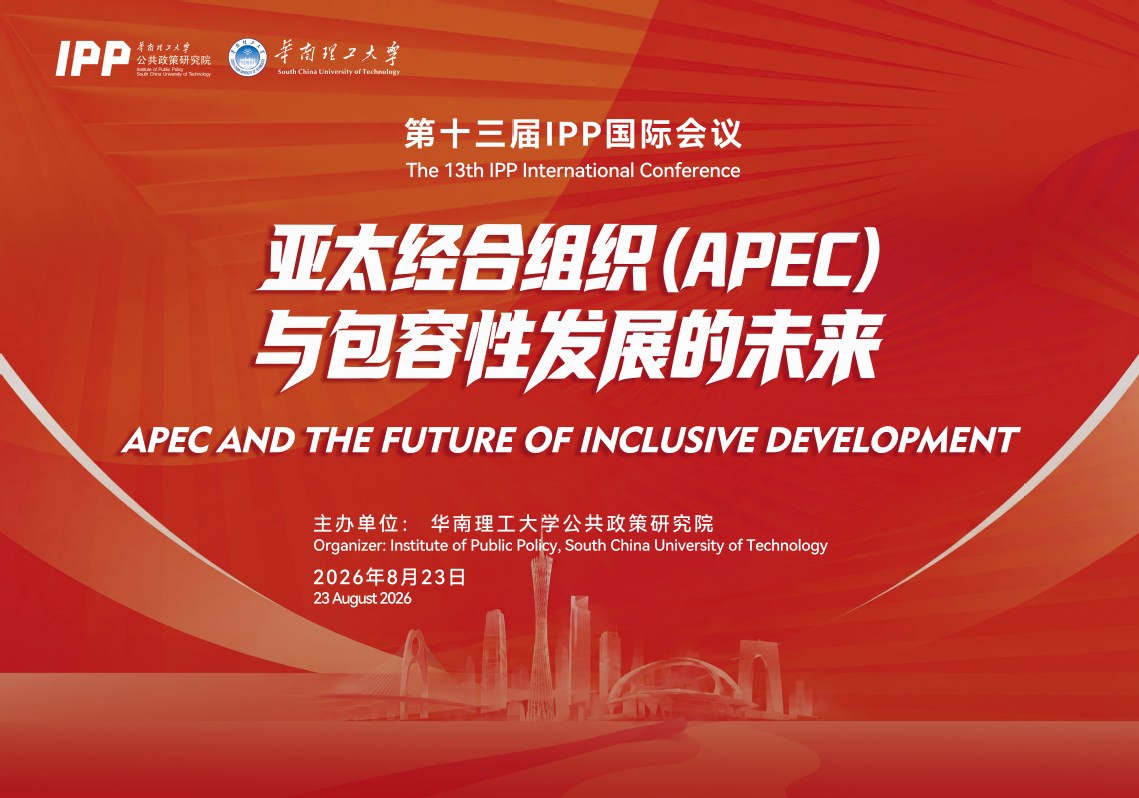
APEC and the Future of Inclsive Development
The Asia-Pacific Economic Cooperation (APEC), established in 1989, has long stood as a cornerstone of regional economic integration, anchored in the principle of ‘open regionalism’. By promoting openness, inclusiveness, and voluntary cooperation, APEC has helped sustain growth and interdependence across economies that today account for around 60 percent of global GDP. Yet nearly four decades on, this model faces mounting strain. The retreat of the United States from multilateral leadership, intensifying geopolitical tensions within the region, and the fragmentation of global supply chains are eroding the foundations of cooperation. At the same time, transformative forces—ranging from artificial intelligence to climate change and energy transition—are reshaping development pathways and testing the resilience of APEC’s existing framework.
Against this backdrop, China’s hosting of the APEC Summit in Shenzhen in 2026 presents a critical juncture to reassess the future of open and inclusive development in the Asia-Pacific. This conference brings together leading scholars and policymakers to examine whether APEC’s foundational principles can be sustained—or must be adapted—in an era of geo-economic competition and global uncertainty. Can open regionalism continue to serve as a viable organizing principle, or is the region drifting toward fragmentation? What reforms, if any, are needed to ensure APEC remains a meaningful platform for cooperation? In addressing these questions, the conference seeks to contribute to a more forward-looking and policy-relevant vision for regional order in the Asia-Pacific.
Conference Agenda
Date: 22-24 August 2026
Venue: Duxing Building, South China University of Technology, Guangzhou, Guangdong, China
Conference Convener: Professor Zheng Yongnian (Chair of Academic Committee, Institute of Public Policy, South China University of Technology; Board Director of Guangzhou Institute of the Greater Bay Area; Deng Presidential Chair Professor, the Presidential Chair Professor, the Founding Director of the Advanced Institute of the Institute for International Affairs, the Chinese University of Hong Kong, Shenzhen)
Agenda on the Conference Day (Day 2)
9:00 – 9:30 | Opening Remarks by Government Officials, University Leadership and Chair of IPP’s Academic Committee |
9:30 – 10:45 | Keynote Speech: ‘Open Regionalism Revisited: History and Challenges’
Keynote Speaker: Edward Yau|Distinguished Nonresident Fellow, Centre on Contemporary China and the World (CCCW), University of Hong Kong; Former Secretary for Commerce and Economic Development, Hong Kong SAR |
10:45 – 11:00 | Coffee Break |
11:00 – 12:15 | Panel 1: APEC at a Crossroads:Institutional logics, membership, and the challenges of organizational informality
Key questions: ·How effective is APEC’s non-binding, voluntary model in today’s context? ·How does APEC position itself in relations to CPTPP and RCEP? ·Should APEC evolve toward a more structured institutional identity? ·How can APEC facilitate cooperation between competing economic blocs?
Moderator: Liu Jia | Research Fellow, Institute of Public Policy, South China University of Technology
Speakers: Shiro Armstrong|Professor of Economics, Crawford School of Public Policy, Australian National University; Research Associate, New Zealand APEC Study Centre Jayant Menon|Senior Fellow at ISEAS – Yusof Ishak Institute and Former Lead Economist at the Asian Development Bank Wang Jiangyu|Professor of Law and Director of the Centre for Chinese and Comparative Law (CCCL) at the City University of Hong Kong School of Law |
12:15 – 14:00 | Lunch Time |
14:00 – 15:15 | Panel 2: Economic Integration of the Asia Pacific: Trade, Industrial Policy, and Economic Security
Key questions: ·Can industrial policy and free trade coexist in an era of strategic competition? ·How are APEC economies recalibrating between efficiency and security? ·Is the region moving toward competing integration regimes, or layered coexistence?
Moderator: Xu Weijun|Associate Research Fellow, Institute of Public Policy, South China University of Technology
Speakers: Mehri Madarshahi|International Fellow, Center for China and Globalization (CCG); Vice Chairman, Asia-Pacific Exchange and Cooperation Foundation; Senior Economist, United Nations, New York (Emeritus); Honorary Professor, Institute of Public Policy, South China University of Technology Xing Yuqing|Professor of Economics, National Graduate Institute for Policy Studies (GRIPS) Ji Xianbai|Associate Professor, School of International Studies; Director, Institute for South and Southeast Asian Studies, Renmin University of China Ivan Danilin|Deputy Director for Scientific Work, Primakov Institute of World Economy and International Relations (IMEMO), Russian Academy of Sciences |
15:15 – 15:30 | Coffee Break |
15:30 – 16:45 | Panel 3: Innovation and Inclusive Development
Key questions: ·Can APEC provide a platform for coordinating sustainability and digital standards? ·How can developing economies finance and sequence the green transition without sacrificing growth? ·Will AI and digitalization narrow or widen development gaps within APEC?
Moderator: Chen Jiahui|Assistant Research Fellow, Institute of Public Policy, South China University of Technology
Speakers: Chul Chung|President of the Korea Economic Research Institute, Chief Research Officer of the Federation of Korean Industries, Co-chair of KOPEC Guillaume Lafortune|Vice President and Head of SDSN Asia at the UN Sustainable Development Solutions Network; Professor at Sunway University, Kuala Lumpur, Malaysia Hans d’Orville|Former Deputy Director-General and Assistant Director-General for Strategic Planning, UNESCO; Honorary Professor, Institute of Public Policy, South China University of Technology |
16:45 – 17:30 | Roundtable Discussion: The Future of Inclusive Development
Guiding Questions: ·How can APEC preserve its identity as a neutral convening platform amid intensifying great-power rivalry? ·What constructive roles can middle powers play in supporting openness and cooperation in the Asia-Pacific? ·What constructive measures can be adopted to enact more equitable growth within and among APEC economies?
Host: Guo Hai|Executive Dean and Research Fellow, Institute of Public Policy, South China University of Technology
Participants: Edward Yau|Ji Xianbai|Shiro Armstrong|Chul Chung |
17:30 – 17:45 | Concluding Remarks |