



Introduction
Long before it became a theatre of geopolitical calculation, the Arctic was a stabilizer of life on Earth. Its vast ice sheets reflect solar radiation back into space, moderating global temperatures. Its cold waters help regulate thermohaline circulation, influencing weather systems across continents. Its permafrost has locked away immense quantities of carbon accumulated over millennia.
Historically, the region has shaped atmospheric balance, sea levels, and biodiversity patterns. Indigenous communities adapted to its harsh but stable rhythms. Global climatic equilibrium depended, in part, on its frozen continuity.
Today, that stability is eroding. Accelerated ice melt, rising temperatures, and ecological disruption are transforming this fragile environment at an unprecedented pace. Arctic amplification, the phenomenon by which the region warms at more than twice the global average- is disrupting ice albedo effects, accelerating permafrost thaw, and destabilizing ecosystems. As ice disappears, darker ocean surfaces absorb more heat. Methane and carbon dioxide are released from thawing soils. Freshwater influx alters ocean salinity and circulation.
These changes are not the result of natural cycles alone. They are closely linked to human-induced global warming, industrial expansion, and decades of insufficient climate governance.The Arctic, once perceived as a distant and frozen periphery, has rapidly emerged as one of the most consequential regions of the twenty-first century.
What is unfolding in the Arctic today reflects a deeper crisis of planetary stewardship. It also reveals a growing crisis of international order. As ice retreats and new spaces open, major powers are moving rapidly to secure strategic positions, economic advantages, and security footholds. The United States, Russia, China, European states, and Canada increasingly view the region not only as an environmental frontier, but as a zone of influence, competition, and potential confrontation.
The transformation of the Arctic, therefore, cannot be understood as an isolated environmental event. It is the cumulative outcome of economic models and political choices made over decades across the world. Inaction, short-termism, and weak international coordination have allowed climate risks to accumulate faster than governance mechanisms could respond in this region.
As ice retreats, previously inaccessible spaces are becoming increasingly open to human activity. New maritime routes promise shorter connections between major markets. Vast reserves of hydrocarbons, rare earth elements, and strategic minerals are attracting commercial and political interest. Tourism, fisheries, and infrastructure development are expanding into fragile zones.
What climate change has, therefore, produced, paradoxically, is not only environmental loss, but also new arenas for economic and military positioning. Ports, airfields, satellite facilities, and surveillance systems are being expanded or modernized. Naval deployments and joint exercises are increasing. Strategic doctrines are being adjusted to Arctic realities.
II. Climate Transformation and Strategic Repositioning
As Arctic warming accelerates, climate change is no longer treated merely as an environmental issue, but has increasingly become embedded in national security planning.
NATO’s evolving posture, Russia’s securitization of its northern frontier, China’s expanding scientific and logistical presence, and competing economic projects are reshaping the regional balance.
The emerging rivalry among powers is not only confined to military affairs, but it also extends to legal claims, investment flows, scientific cooperation, data control, and institutional influence.
For the United States, the Arctic has become central to missile warning systems, space surveillance, and transatlantic defence architecture. Greenland -as a center of contentious discussions recently- occupies a pivotal position between North America and Europe, reinforcing Washington’s interest in consolidating its strategic presence.
Russia treats the Arctic as a core national security frontier. It has expanded military bases, modernized icebreaker fleets, and integrated the Northern Sea Route into its defence and economic strategy. For Moscow, the High North represents both strategic depth and geopolitical leverage.
China, defining itself as a “near-Arctic state,” has intensified scientific missions, logistics development, and commercial engagement through its Polar Silk Road framework. These activities, while framed as civilian, are widely interpreted in the West through the lens of systemic rivalry.
Canada and Nordic states have strengthened sovereignty patrols, surveillance systems, and northern infrastructure. NATO exercises increasingly incorporate Arctic scenarios, reflecting the region’s integration into alliance security planning.
In this evolving context, climate change functions as a strategic accelerator. It compresses timelines, intensifies competition, and weakens the buffer once provided by geography.
If current trends continue, the Arctic risks becoming another arena in which fragmented governance and power politics override collective responsibility.
The Arctic is no longer merely warming; it is becoming a central arena of strategic repositioning, and Arctic governance mechanisms, designed for an era of low tension, are increasingly strained by mistrust and geopolitical spillovers.
III. Greenland and the Strain on Alliance Governance
In recent years, Greenland has emerged as a hard strategic focus for the United States. Greenland occupies a pivotal geostrategic location at the intersection of the North Atlantic, the Arctic Ocean, and the North American and European landmasses. Its position makes it a linchpin for early-warning systems, missile defence infrastructure, space and air monitoring, and control of the GIUK (Greenland,Iceland,UK) naval gap, a critical chokepoint for transAtlantic naval movements and nuclear deterrence.
As an autonomous territory within the Kingdom of Denmark, Greenland occupies a sensitive position in transatlantic security arrangements. For decades, U.S. defence installations coexisted with Danish sovereignty and alliance cooperation. Under longstanding defence arrangements between the U.S. and Denmark, American military forces have maintained a presence in Greenland, notably at Pituffik Space Base. But recent political rhetoric by U.S. leadership has gone beyond traditional security cooperation to advocate for direct control or acquisition of the island, even floating the idea that it could become formally American territory. This is a striking departure from post-World War II NATO norms.
Expressions of American interest in greater control over infrastructure and resources have raised concerns within the European Union and NATO.
European governments have reacted sharply. Several EU and NATO members issued joint statements asserting that Greenland’s future is an internal matter for Denmark and its autonomous authorities, and warning that any attempt by the United States to seize control-even rhetorically- threatens the very foundation of alliance solidarity. Some European leaders framed this dispute as a challenge to the spirit of Article 5 of the North Atlantic Treaty, which commits allies to mutual defence against external aggression. In the hypothetical scenario of a U.S. use of force against a fellow NATO territory, the logic of collective defence would face its most extreme test: would Article 5 obligate Europe to defend Denmark against Washington? European officials have described such a possibility as a fundamental crisis for the alliance.
These moves are widely perceived as testing alliance norms based on mutual respect for sovereignty and collective defence.
The dispute has also triggered discussions within NATO about enhancing a European defence pillar and adjusting operational concepts in the Arctic to ensure that strategic cooperation does not unravel amid transatlantic disagreements.
At stake is more than a bilateral disagreement. The Greenland issue exposes a deeper tension within Western security arrangements: between cooperative governance and unilateral strategic calculation.
If alliance members pursue territorial or infrastructural advantage at the expense of partners, the credibility of collective defence frameworks is weakened. The logic of Article 5, built on trust and reciprocity, becomes vulnerable to political reinterpretation.
Greenland thus illustrates how climate-driven strategic repositioning can destabilize institutional foundations. Environmental change is opening physical space while placing stress on the political architecture of cooperation.
IV. The Immediate and Long-Term Human Consequences
As we argued in this article, climate change has produced, paradoxically, not only environmental loss, but also new arenas for economic and military positioning. Ports, airfields, satellite facilities, and surveillance systems are being expanded or modernized. Naval deployments and joint exercises are increasing. Strategic doctrines are being adjusted to Arctic realities.
Environmental degradation has thus been translated into geopolitical leverage.
Access to routes, resources, and logistical hubs is no longer determined by geography alone, but by technological capacity, financial strength, and political alignment. States capable of operating in extreme conditions gain disproportionate advantages. Others risk strategic marginalization.
In this context, the Arctic is being redefined-not as a shared ecological heritage- but as a contested strategic space.
Recent scientific research and investigative reporting reveal that Arctic melting is no longer an abstract risk. It is triggering systemic changes that threaten water security, ecosystems, economic stability, and human health.
The past decade has been the warmest on record in the Arctic. Winter sea ice reached historic lows in 2025, according to National Oceanic and Atmospheric Administration. Meanwhile, the European Union’s observation programme Copernicus, warns that global temperatures are approaching 1.5°C earlier than anticipated.This acceleration reflects continued growth in fossil fuel emissions and weak international climate coordination.
One of the most alarming consequences is the degradation of freshwater systems.
In Alaska’s Brooks Range, more than 200 rivers have turned rust-orange as thawing permafrost releases iron, manganese, nickel, and aluminium into circulation. Research involving the University of Alaska Fairbanks confirms that this “rusting river” phenomenon is driven by climate change. As permafrost thaws, minerals and organic matter that were frozen for millennia become chemically active. Exposure to oxygen and acidic water triggers reactions that leach metals into river systems.
Once initiated, these chemical processes are effectively irreversible.
Similar transformations are emerging in mountain regions across Europe, including the Alps and Pyrenees, signalling broader geochemical disruption.
Permafrost thaw also releases massive quantities of greenhouse gases. According to researchers at the Woodwell Climate Research Center, microbial activity in thawing soils creates feedback loops that accelerate warming.
Estimates by The Arctic Institute suggest that global permafrost contains up to 1.7 trillion tonnes of carbon- roughly forty-five times the total emissions produced by all countries in 2024. If released even partially, this reservoir could fundamentally destabilize climate mitigation efforts.
For Arctic communities, these changes are already translate into social and economic disruption.Drinking water become contaminated. Building collapse. Coastal erosion forces relocatation. Traditional livelihoods based on hunting, fishing, and seasonal migration are increasingly undermined.
It is estimated that, by 2100, near-surface permafrost may largely disappear. This would intensify wildfires, flooding, land collapse, and infrastructure failure across polar regions.
What is unfolding is not simply environmental degradation. It is the slow dismantling of human habitats.
More broadly, scientists warn that crossing critical climatic thresholds could trigger irreversible changes across Earth’s systems, endangering economic growth, food security, and public health worldwide.
The Arctic has become a global risk multiplier.
V. Governance, Order, and the Future
As was mentioned earlier in this article, the Arctic Council and existing governance mechanisms were designed for an era of low geopolitical tension. Today, polarization, sanctions, and strategic mistrust strain these frameworks.
Environmental management is increasingly subordinated to security calculation. Scientific cooperation is politicized. Transparency declines.
If rivalry overtakes responsibility, the Arctic may become another arena of fragmented governance, reflecting wider fractures in the international system.
Yet another path remains possible.
The Arctic could become a laboratory for renewed multilateralism- integrating climate mitigation, indigenous rights, security transparency, and sustainable development under shared rules.
The choice is not between development and preservation. It is between short-term competition and long-term planetary stability.
Conclusion: A Test of Global Maturity
The melting Arctic is not merely a regional transformation. It is a test of whether humanity can reconcile power politics with ecological limits.
If climate breakdown becomes an accelerant of militarization and rivalry, the consequences will extend far beyond the polar circle. If, however, states recognize that Arctic stability underpins global stability, cooperation may yet prevail.
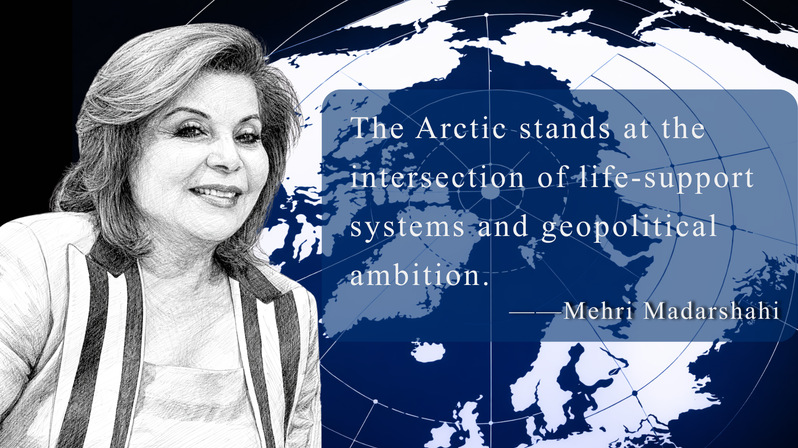
The Arctic stands at the intersection of life-support systems and geopolitical ambition.
How it is governed will reveal much about the world order now taking shape.
By:Professor Mehri Madarshahi
Honorary Professor of The Institute of Public Policy (IPP) ,South China University of Technology (SCUT) ; Member of the Advisory Committee of the International Center for Creativity and Sustainable Development under the auspicious of UNESO (ICCSD)