



The Munich Security Conference is taking place from 13 to 15 February. European leaders, together with major geopolitical actors such as China and Iran, have gathered to express and exchange their positions on the war in Ukraine, a conflict that has persisted for four years since Russia launched its “Special Military Operation” on 22 February 2022. With more than two million casualties on both sides combined, the scale of devastation underscores the urgency of the moment. European leaders increasingly frame the conflict not only as a test of Ukraine’s resilience, but as a test of Europe’s own geopolitical agency: Can Europe act collectively as a geopolitical power?
By June 2025, the European Union had surpassed the United States as the primary provider of military assistance to Ukraine. Yet despite repeated declarations of solidarity and sustained financial and military support, the 27-member bloc has stopped short of organizing any direct military intervention against Russia.
The institutional roots of Europe’s paralysis in collective security are not difficult to identify. The European Union lacks a unified military command structure, and its defense landscape remains deeply fragmented. It operates roughly 178 different weapons systems, compared to about 30 in the United States. A 2017 EU document noted that Europe fields 20 types of fighter aircraft (the U.S. has 6), 29 classes of frigates (the U.S. has 4), and 17 types of main battle tanks (the U.S. effectively 1). As the report dryly observed, “there are more helicopter producers in Europe than there are governments able to buy them.”
Diversity is a principle the EU rightly celebrates in political and cultural terms. On the battlefield, however, such diversity often translates into duplication, interoperability gaps, logistical inefficiencies, and structural vulnerabilities. These weaknesses have historically been mitigated—indeed, enabled—by the American security umbrella within NATO. The sheer proliferation of weapons platforms means that even if the EU possessed the political will to establish a unified army, it would still face formidable technical, industrial, and politico-economic obstacles. Harmonizing procurement standards, integrating command-and-control systems, consolidating defense industries, and overcoming entrenched national interests are tasks that would take decades, not years. Therefore, as long as the United States continues to serve as a credible security guarantor within NATO, European states have little incentives to incur the political and economic costs of building a fully autonomous EU army.
However, Russia’s unrelenting aggression against Ukraine under Vladimir Putin, coupled with the unapologetic retrenchment of U.S. security guarantees under Donald Trump, has at last delivered a stark wake-up call to Europe. For years, the continent drifted strategically, relying on assumptions that no longer hold. European leaders have stumbled in their response, slow to grasp the scale of the geopolitical shift now underway. Yet the realization is dawning – Europe has been geopolitically dormant for too long. If it is to safeguard its collective security and preserve strategic autonomy, it must now take bold and coordinated action, before it is too late.
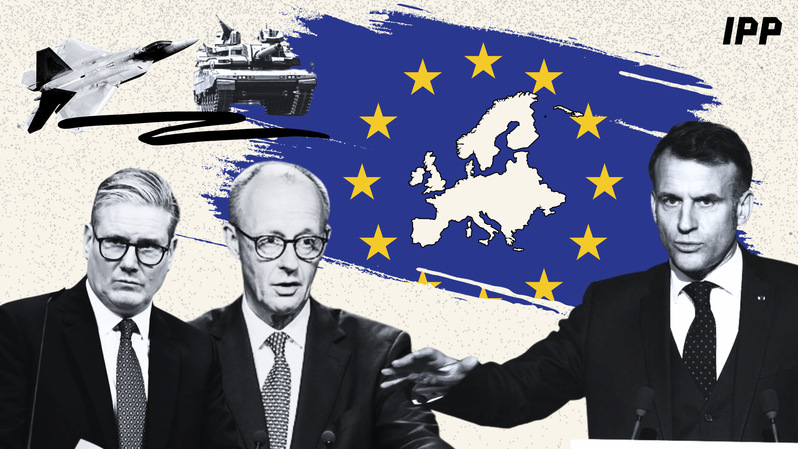
The renewed sense of urgency was clearly articulated at the Munich Security Conference, particularly in the remarks of French President Emmanuel Macron, UK Prime Minister Keir Starmer, and German Chancellor Friedrich Merz.
Macron, delivering a 30-minute speech in fluent English, spoke with striking urgency: “Europe has to learn to become a geopolitical power.” His vision extended well beyond the traditional Franco-German axis. “We have to think and act as Europe by design,” he insisted. “We have to think now, at the European scale.” His message was clear: Europe must move from coordination to strategic cohesion.
Starmer struck a similarly alarmed tone, describing Europe as a “sleeping giant” that “must build hard power, because it is the currency of the age.” His emphasis on defense capabilities and deterrence reflected a growing consensus that values alone are insufficient without the means to defend them.
Yet it was Merz who delivered the most shocking assessment. He suggested that “the U.S. claim to leadership has been challenged and possibly lost,” and that the international rules-based order “no longer exists in that form.” Germany, he announced, is targeting defense spending at 5% of GDP. He also revealed discussions with Macron about the possibility of establishing a European nuclear umbrella—an idea that would have been politically unthinkable in Berlin only a few years ago.
Most strikingly, Merz drew an explicit ideological line between Europe and the United States. “The culture war of the MAGA movement is not ours,” he declared. “Freedom of speech ends here with us when that speech is directed against human dignity and the Basic Law. We do not believe in tariffs and protectionism, but in free trade. We stand by climate agreements and the World Health Organization.” Merz signaled that Europe’s strategic awakening is not merely military—it is also normative, reflecting a widening divergence in political identity across the Atlantic.
No less striking was the intervention of Marco Rubio, the U.S. Secretary of State. Rubio largely succeeded in re-engaging European audiences by framing transatlantic relations in civilizational terms. Rather than lecturing Europe on democracy and free speech in a tone of reproach—as JD Vance had done at last year’s conference—or attributing Europe’s strategic hesitations to bureaucratic fragmentation, Rubio adopted a deeper, more emotive register.
Rubio portrayed the United States as “the child of Europe,” with bounds in common culture, institutions, and Christian faith. “We are connected spiritually and we are connected culturally,” he declared. He even recast Donald Trump’s past criticism of Europe as a form of familial, if not fraternal, affection: “Ultimately, our destiny is, and always will be, intertwined with yours… we care deeply about your future and ours.”
In Rubio’s telling, Europe’s malaise does not primarily stem from economic stagnation or institutional shortcomings. Rather, he argued, it arises from a deeper spiritual crisis: Europe is “shackled by guilt and shame,” and has surrendered its confidence, masculinity, and will-to-power to what he characterized as leftist, woke ideologies. This is powerfully expressed in his speech as followed:
An alliance that we want is one that is not paralyzed into inaction by fear. The only fear we have is the fear of the shame of not leaving our nations prouder, stronger, and wealthier for our children; an alliance ready to defend our people, safeguard our interests, and preserve the freedom of action that allows us to shape our own destiny—not one that exists to operate a global welfare state and atone for the purported sins of past generations. An alliance that does not allow its power to be outsourced, constrained, or subordinated to systems beyond its control; one that does not depend on others for the critical necessities of its national life; and one that does not maintain the polite pretense that our way of life is merely one among many—and that asks for permission before it acts.
Rubio reframed the transatlantic debate. Rubio’s diagnosis suggests that Europe’s passivity over the war in Ukraine stems from a deeper form of civilizational self-denial. He presented a narrative of decline, of a society weakened by excessive inclusiveness, naïveté about human nature, and complacency in self-defence.
Whether such narrative can truly awaken Europe’s “sleeping giant,” however, is another matter. Judging by Europe’s actions thus far in the Ukraine war, the continent appears cautious at best—and perhaps still strategically hesitant, if not deliberately restrained.
Keir Starmer, at the Munich Security Conference, announced that the United Kingdom would deploy its carrier strike group to the North Atlantic and the High North. Yet he stopped short of outlining any direct measures against Russian forces. The signal was one of deterrence and presence rather than escalation.
Emmanuel Macron’s posture remains similarly measured. Although Russian intelligence sources have claimed that Paris has committed 100 Rafale fighter jets and authorized private military contractors to assist Ukraine, the direct involvement of the French armed forces remains limited. More importantly, Emmanuel Macron is unlikely—politically and socially—to secure domestic support for formal entry into a war with Russia.
As for Friedrich Merz, his proposals to raise defense spending dramatically and to explore participation in a European nuclear umbrella alongside France appears ambitious and assertive. Yet, Germany’s defense strategy still remains primarily defined by defensiveness rather than proactive interventionism.
Taken together, the gap between words and actions of the European states suggests not a continent fully awakened to geopolitical confrontation, but one cautiously recalibrating—seeking stronger strategic alignment and greater military spending, while remaining reluctant to cross the threshold into direct war.
Beyond the absence of a unified military command structure, at least three additional factors have constrained European governments from taking further action against Russia.
First, public opinion imposes clear limits. While many Europeans perceive a high risk of war with Russia and support stronger assistance to Ukraine, they are far less willing to contemplate direct military confrontation themselves. A December 2025 poll conducted by Cluster 17 for Le Grand Continent found that more than two-thirds of Europeans doubt their country’s ability to defend itself militarily against a Russian attack. It is one thing to endorse Ukraine’s struggle in principle; it is quite another to risk one’s own life in a direct conflict.
Second, from a strategic standpoint, entering a war with Vladimir Putin’s Russia without firm and unified backing—particularly from the United States—appears exceedingly risky. By contrast, acquiescing to some form of territorial compromise in eastern Ukraine may seem, however cynically, less costly, at least in the short term. One of the unspoken questions at the Munich Security Conference is the extent of Europe’s commitment to Ukraine’s eastern provinces. While European leaders consistently affirm their moral and economic support for Kyiv, they have been careful to avoid explicit security guarantees regarding those territories. Their posture might be captured by a German proverb: too little to live, too much to die.
Finally—and here Rubio’s critique resonates—there is a deeper moral crisis behind Europe’s geopolitical passivity. Europe has produced no shortage of speeches and conferences affirming solidarity with Ukraine. Yet beneath the abundance of words and dialogues lie two unspoken impulses: first, the hope that someone else will ultimately bear the decisive burden; and second, more importantly, the quiet reassurance that in the absence of full unity, responsibility remains diffuse. The expectation of prior military unification has, paradoxically, become a precondition for, and an obstacle to, effective action.
Emmanuel Macron is correct in pointing out that Europe must learn to act as a geopolitical power. But Europe still seems to be waiting—for public opinion to harden, for institutions to align, for history to clarify its demands. Such clarity rarely arrives on schedule. If Europe is serious about safeguarding itself, it must act now.