



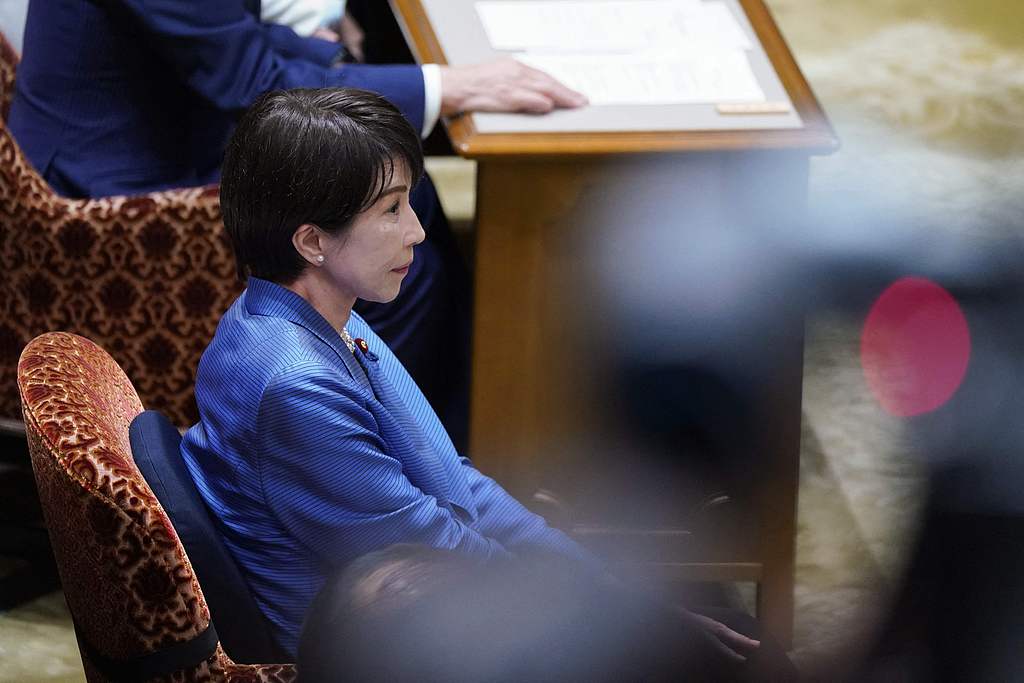
Japan's Prime Minister Sanae Takaichi attends a debate with opposition party leaders in the National Diet in Tokyo on November 26, 2025. /VCG
Editor's note: Xu Weijun is an assistant research professor at the Institute of Public Policy, South China University of Technology. His research interests include East Asian international relations, nationalism, Chinese diplomacy, and China-U.S. relations. The article reflects the author's opinions and not necessarily those of CGTN.
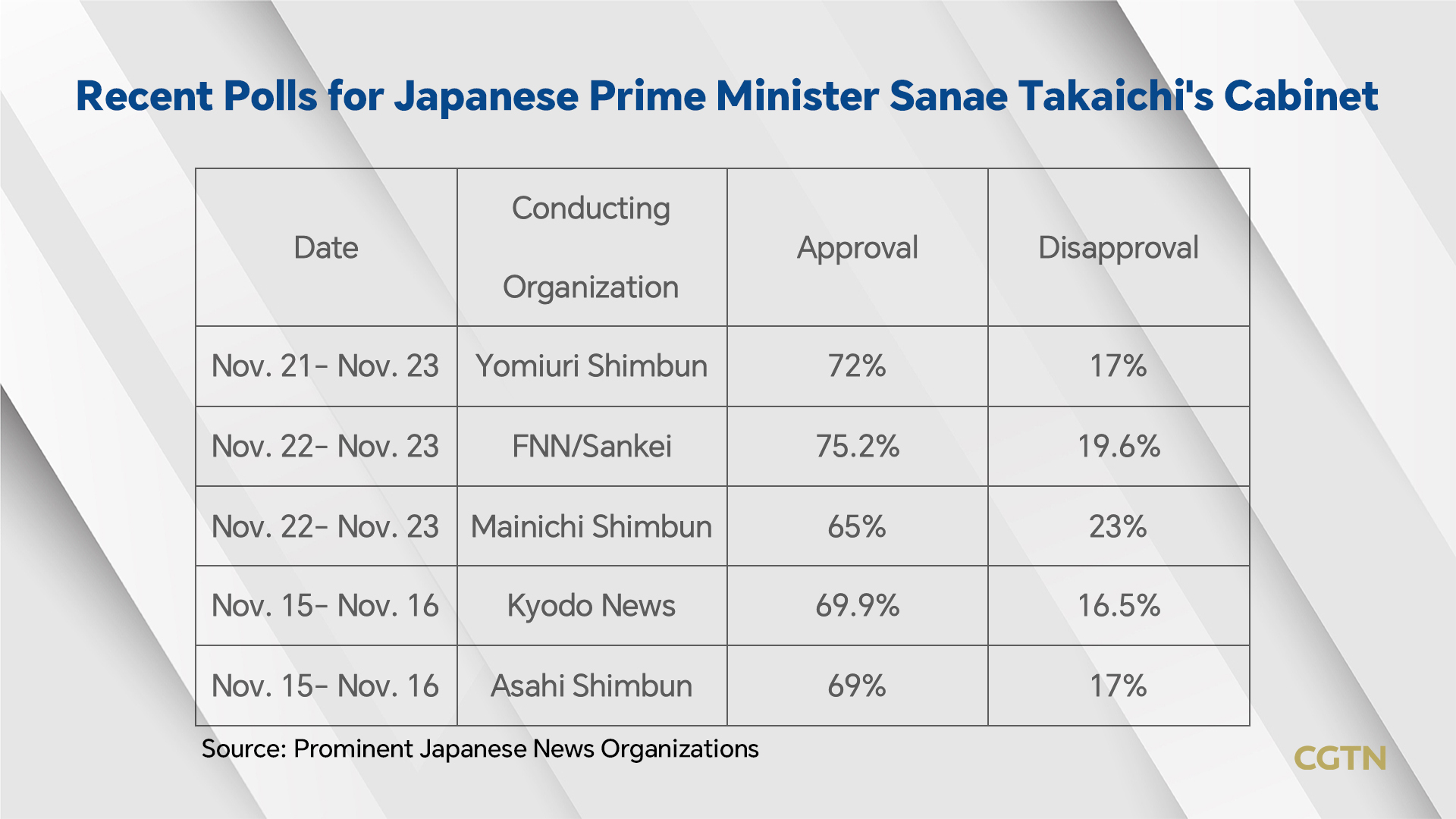
Recently, the erroneous remarks on Taiwan region made by Japanese Prime Minister Sanae Takaichi have led to a sharp deterioration in Sino-Japanese relations. In response, the Chinese side initiated a series of resolute countermeasures, and voices criticizing her remarks also emerged within Japan. However, recent opinion polls conducted by Japanese mainstream media outlets suggest that the approval ratings of the Takaichi Cabinet have not declined noticeably, and in some cases, have even shown a slight upward trend. As shown in the table below, recent polls conducted by prominent Japanese news organizations, including the Yomiuri Shimbun, Sankei Shimbun, Mainichi Shimbun, Asahi Shimbun and Kyodo News, have indicated that the Takaichi Cabinet's approval rating has remained consistently high, at around 70 percent or above. It is important to note that this approval rate should not be conflated with the Japanese public's endorsement of Takaichi's erroneous remarks on Taiwan, nor does it imply that China's countermeasures have failed to have a real impact.
This seemingly paradoxical phenomenon stems primarily from the following four factors.
Firstly, changes in Japan's domestic political culture and voter demographics have provided the social foundation for the Takaichi Cabinet. In recent years, there has been a marked shift in the ideological inclinations of Japanese society, characterized by a rightward and conservative transition. Traditional anti-war and pacifist rhetoric has steadily lost influence among the public, while the influence of right-wing nationalism has gradually grown. This trend is further reflected in the rise of the far-right Sanseito over the past few years. Many right-leaning Japanese citizens appear to have an inadequate understanding of the severe consequences that a deterioration in Sino-Japanese relations could incur. Their stance is driven more by right-wing nationalist sentiment, advocating for the Japanese government to adopt a tougher stance towards China. Consequently, despite the severe conflict between China and Japan that was provoked by Takaichi's erroneous remarks on Taiwan, this segment of the electorate has not withdrawn its support for the Takaichi administration.
Secondly, the framing of discourse and the rally 'round the flag effect have consolidated public support for the Takaichi Cabinet. In the recent Sino-Japanese dispute, Japanese mainstream media and certain opinion leaders have deliberately framed China's countermeasures as diplomatic coercionor external pressure. This framing serves to redirect public attention towards an artificially constructed external threat, thereby diminishing their awareness of criticizing the Takaichi Cabinet's erroneous policies. Therefore, as China's countermeasures progressed, a short-term rally 'round the flag effect emerged among Japanese citizens who underestimated the severity of the consequences. This has directed their sentiments more towards the dissatisfaction with perceived external threat rather than towards Takaichi's erroneous policies. Consequently, these sentiments were transformed into support for Takaichi's tough stance.
Thirdly, the multidimensional composition of cabinet approval ratings dilutes the relative importance of Taiwan-related issues in opinion polls. In such polls concerning cabinet approval, Sino-Japanese relations are not primary concerns for most Japanese citizens. According to survey data, the Japanese public's expectations for Takaichi primarily lie in the economic domain, particularly the effectiveness of her economic program, often referred to as Sanaenomics. For instance, in the aforementioned Yomiuri Shimbun poll, 74 percent of respondents expressed positive views on the prime minister's pursuit of responsible and active fiscal policy, with only 17 percent disapproving. Even within the realm of foreign affairs, Sino-Japanese relations constitute merely one facet among multiple issues. Despite the setbacks in Sino-Japanese relations, Takaichi has conducted a series of successful multilateral diplomatic engagements, notably through the ASEAN Summit, the APEC Leaders' Meeting and the G20 Summit. She has also achieved favorable diplomatic outcomes with the U.S. Donald Trump administration. These diplomatic achievements have contributed to an overall positive record in the Takaichi Cabinet's foreign policies in the eyes of most Japanese citizens. Also according to the Yomiuri poll, 56 percent of respondents expressed a favorable opinion of the cabinet's stance towards China. The figure was significantly lower than the overall approval rating of the cabinet. However, regarding Takaichi's summit with President Trump in October, 77 percent of respondents rated her performance well.
Fourthly, it takes time for tensions in Sino-Japanese relations to be transmitted to the level of public opinion. China's countermeasures have mainly targeted on specific sectors of the Japanese economy. The impact of these measures on the general public and the resulting sentiment towards the government can take a considerable amount of time to manifest. Thus, in the early phase of the dispute, Japanese public opinion may still lean towards supporting or tolerating the erroneous stance of the Takaichi Cabinet. However, should China's countermeasures continue to escalate and produce considerable negative effects on people's daily lives, the resulting economic pressures are likely to gradually turn into political discontent. And the approval ratings for the Takaichi Cabinet could then undergo a substantial decline.
Overall, Japan's current political landscape makes it difficult for the Takaichi Cabinet to retract its erroneous remarks in the short term, and the deterioration in Sino-Japanese relations is likely to persist for an extended period. Takaichi Cabinet's policies have been observed to demonstrate a rightward shift in both ideological orientation and policy practice. This political logic, which is centered on mobilizing right-wing supporters, imposes significant constraints on the cabinet's foreign and security policies. Any policy compromise or conciliatory gesture risks being interpreted by right-wing opinion as weak or as a betrayal of national interests, thereby undermining the cabinet's public support.
If China were to allow this incident to fester, it is likely that the Takaichi Cabinet would adopt more dangerous measures concerning Taiwan in the future to sustain its approval ratings. For instance, it might advocate for the enactment of a Japanese analogue to the so-called U.S. Taiwan Relations Act, thereby legislating the framework for Japan's relations with the Taiwan's Democratic Progressive Party (DPP) authorities in domestic law and providing a legal basis for defending Taiwan and for arms transfers to the island. In addition, Takaichi might incorporate Taiwan emergency into Japan's security considerations, employing more explicit language within official discourse and defense documents (such as the defense white papers). This would serve to reduce ambiguity in stances and decision-making delays during crises, while sending clearer signals of support to the DPP authorities. To avert the emergence of such more dangerous prospects, China should maintain its resolute stance and continue to intensify pressure on Japan until the Takaichi Cabinet explicitly retracts its erroneous remarks or clearly affirms the one-China principle and the stipulations on the Taiwan question contained in the four political documents between China and Japan.
Published in CGTN, 26-Nov-2025.